
The book ends with a birth and a list of names.
The list looks skippable. It isn't.
Read it slowly, all the way down. The last name is the one to sit with.
Ruth 4:13-22
Tap a tool, then tap words. Highlight what gets your attention · underline what God is doing or saying · circle a repeated or unfamiliar word.
Read it aloud, then give everyone two minutes to mark it in silence.
13
14
15
16
17
18
19
20
21
22
13
14
15
16
17
18
19
20
21
22
NET Scripture quoted by permission. Quotations designated (NET) are from the NET Bible® copyright ©1996, 2019 by Biblical Studies Press, L.L.C. netbible.com
What stood out?
Go around the room. Each person reads one thing they marked. If you know why it stood out, say so. If you don’t, “it just stood out” is a complete answer. Nobody explains, nobody corrects.
Compare after you’ve marked
- Naomi's journey from bitterness to joy as a testament to God's unexpected faithfulness.
- The birth of Obed as a quiet but significant fulfillment of God's promises.
- The significance of the genealogy that connects Ruth's story to the lineage of Jesus (see Matthew 1:1-6, about a thousand years later).
- How living in anticipation of God's promises shapes our choices, attitudes, and actions as we await their fulfillment.
Your markings are saved on this device and will be here when you come back.
He was there the whole time
Ruth and Boaz marry, and God gives them a son. The women of Bethlehem, the same women who heard Naomi call herself Mara, now say to her: “Blessed be Yahweh, who has not left you today without a near kinsman.” Naomi, who came home empty, holds fullness in her arms. And the child's name is Obed, who becomes the father of Jesse, the father of David. The Moabite widow who gleaned at the edge of a field is a great-grandmother to Israel's greatest king.
The book of Ruth ends with a genealogy: ten names, Perez to David. It reads like the least inspiring paragraph in the book, and it reveals that this small family story has been reaching beyond itself all along. Every ordinary scene we have watched was carrying the royal line of Israel: a widow's loyalty, a farmer's generosity, a night of waiting, a legal exchange at the gate. The story was always bigger than the people living it.
God does not waste any part of the story (Romans 8:28). Even through famine, grief, displacement, and uncertainty, He kept working toward redemption. And He did it through the person nobody expected: a foreign widow with little standing and remarkable loyalty, courage, and initiative. That is how God loves to work. He has promised, “I will in no way leave you, neither will I in any way forsake you” (Hebrews 13:5); Jesus says it even more tenderly: “I will not leave you orphans. I will come to you” (John 14:18).
Matthew opens his Gospel with that same list of names and keeps going, through David, all the way to “Jesus, who is called Christ,” and Ruth is named in it (Matthew 1:5). “They shall call His name Immanuel, which is, being interpreted, ‘God with us’” (Matthew 1:23). The Word became flesh and lived among us (John 1:14). The God who worked silently through every season of Ruth's life stepped into our seasons in person. Every season of your life is also part of a story that ends in Him.
Look back before you look forward. Naomi could not see chapter four from chapter one, but God could. Name where His faithfulness has already surprised you, and let that fuel your trust for the seasons you cannot see past. Live this season, whatever it is, as part of that larger story. Loss, provision, waiting, quiet growth, surprise: God was present in all of them for Ruth, and He is present in all of them for you. Rooted in Christ, you will bear fruit in every season.
Read this one out loud.
The same truth across Scripture
Joseph looks back over a story full of harm and names what Ruth's ending shows: God was working it toward good the whole way, for the saving of many.
The Bible's other book where God never appears on stage. Deliverance still arrives, and an ordinary person finds she was placed in the story on purpose.
Discussion questions
- Why do you think the book of Ruth ends with a genealogy?
- Ruth is named in the family line of Jesus (Matthew 1:5). What does it mean to you that your ordinary faithfulness is part of a bigger story?
- Looking across all seven sessions, from loss to provision to waiting to quiet growth to surprise, which season spoke most to where you are?
- God with us, Immanuel, is how the story lands. How does Jesus' presence change the season you are in right now?
Write it out.
Write freely. Your words are saved in this browser only, on this device, as you type. Nothing you write is sent to us.
Email opens your mail app. We do not store your notes.
Let’s pray together
Read Ruth 4:13-22 aloud again, slowly.
Pray together: “Come, Holy Spirit. Open our eyes to Your presence in this season.”
In pairs or small clusters, pray for one another:
- Where do you need to trust in God's faithfulness?
- Where do you need more hope or expectancy as you wait on God?
- How can we pray for you to live with hope while you wait for what you cannot yet see?
Leave space for silence, listening, and Spirit-led prayer. If someone senses a word, a Scripture, or a picture for another, offer it gently and pray into it.
Let’s pray
Breakthrough is when God's Kingdom breaks into your reality: His healing where there is pain, His freedom where there is bondage, His presence where there is loneliness. Jesus is King; His freedom, peace and purpose are available now. Pray from that Kingdom, not toward it.
Be still for a moment. Open your hands and simply pray: “Come, Holy Spirit.”
Ask: “What do You want me to know right now? What were You highlighting when I marked the passage?” Stay open to a word, a Scripture, a picture, or a prompting.
Pray boldly into what He shows you. Ask for His Kingdom in the specific places this session touched:
- Where is it hard to trust God's faithfulness right now?
- Bring this season, whatever it is, to Jesus, God with us.
- Ask Him to fill you with eager expectation, and to let that hope shape how you move forward.
You can pray more than once. Stay present, and trust that God is at work. Take your time; there is no hurry.
Choose one. Say it out loud so someone else hears it.
Next time you gather, share what you practiced and how God used it, not for pressure but for encouragement.
The reminder downloads as a calendar event. Open it and it lands on your calendar for tomorrow morning.
Back into the passage
You have the teaching now. Go back with it, on your own this week or right now:
- Go back to what you marked. Repetition often matters. What word, phrase, or idea repeats, and what might the author be drawing your attention to?
- What does this passage show you about God: His character, His timing, His way of working?
- What surprised you, or ran against what you expected? Sit with that. Ask the Spirit why it caught you.
- Is there a promise to trust, a command to follow, or an example to learn from?
- Pay attention to what got your attention. What might the Spirit be highlighting for your life right now?
Done.
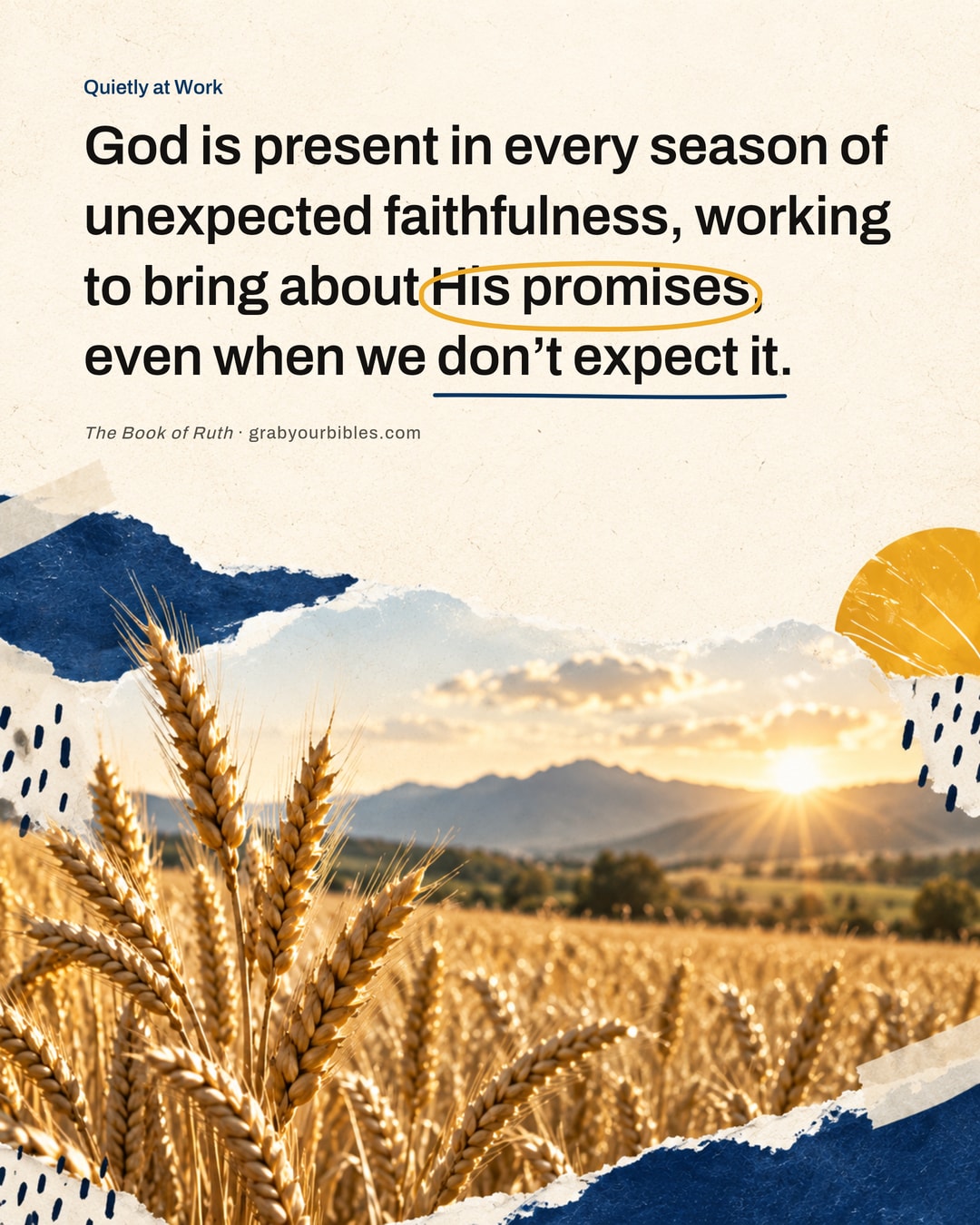
God is present in every season of unexpected faithfulness, working to bring about His promises, even when we don't expect it.