
They are rowing into the wind in the dark and getting nowhere.
He does not stop the storm first. He comes out onto it.
Read what He says when He gets there, and hold onto the exact words.
Mark 6:45-52
Tap a tool, then tap words. Highlight what gets your attention · underline what God is doing or saying · circle a repeated or unfamiliar word.
Read it aloud, then give everyone two minutes to mark it in silence.
Read the passage slowly. Notice what the disciples are feeling, where Jesus shows up, and what He says. What details stand out? What surprises you? How does this moment reveal who God is?
Circle every question mark.
NET Scripture quoted by permission. Quotations designated (NET) are from the NET Bible® copyright ©1996, 2019 by Biblical Studies Press, L.L.C. netbible.com
What stood out?
Go around the room. Each person reads one thing they marked. If you know why it stood out, say so. If you don’t, “it just stood out” is a complete answer. Nobody explains, nobody corrects.
Your markings are saved on this device and will be here when you come back.
Take courage. It is I. Don’t be afraid.
In Mark 6, the disciples are exhausted, rowing against the wind in the dark. Jesus sees them struggling, walks on the water toward them, and speaks words they desperately need: “Take courage. It is I. Don’t be afraid” (6:50). Jesus says ego eimi, “It is I.” For readers steeped in Scripture, the wording can also echo the language of divine self-identification, especially within a scene where Jesus is doing what Israel’s Scriptures associate with God: coming over the waters.
Jesus doesn’t calm the storm first. He comes to them first. God does not wait for the storm to quiet before He draws near.
Earlier in chapter 6, Jesus feeds the five thousand, taking Yahweh’s place as the One who provides bread in the wilderness. In 6:56, people flock to Him simply to touch the edge of His cloak because they sense God’s healing presence in Him.
In chapter 7, Jesus confronts empty religion and exposes the ways people honor God with their lips while their hearts remain far away (7:6). He speaks with Yahweh’s authority, calling His people back to real relationship. Then He heals a deaf and mute man (7:31-37). In Exodus 4:11, Yahweh alone opens ears and loosens tongues. Jesus performs the very work God claims as His own.
Across these chapters, we see a God who comes close, not a God who stays distant. A God who steps into our fear and steadies our hearts. A God who confronts what is false and restores what is broken. A God who draws near on the waves, in the crowd, in spiritual confusion, and in suffering.
Jesus invites us to stop facing fear alone. He comes to us in the wind and the darkness and speaks courage over us. He invites us to trust His presence even when the storm still rages, to let His voice calm the fear inside us, and to believe that He is nearer than we think. His invitation is simple: “Take courage, I am here.”
Read this one out loud.
Discussion questions
- Where do you feel like you’re rowing against the wind right now?
- Which part of Mark 6-7 speaks most clearly to where you are emotionally or spiritually?
- What would it look like to let Jesus speak courage into your situation this week?
Write it out.
Write freely. Your words are saved in this browser only, on this device, as you type. Nothing you write is sent to us.
Email opens your mail app. We do not store your notes.
Let’s pray together
Read Mark 6:50 aloud again, slowly.
Pray together: “Come, Holy Spirit. Bring courage where we feel afraid.”
In pairs or clusters, pray for:
- Peace in anxious or overwhelming places
- Strength for transitions or unknowns
- Healing in places that feel fragile or broken
- Courage to trust Jesus’ presence
Leave space for silence, listening, and Spirit-led prayer. If someone senses a word, a Scripture, or a picture for another, offer it gently and pray into it.
Let’s pray
Breakthrough is when God’s Kingdom breaks into your reality: His healing where there is pain, His freedom where there is bondage, His presence where there is loneliness. Jesus is King; His freedom, peace and purpose are available now. Pray from that Kingdom, not toward it.
Be still for a moment. Open your hands and simply pray: “Come, Holy Spirit.”
Ask: “Father, what am I waiting for you to fix before I will let you near?” Then: “What were you highlighting when I marked the passage?” Stay open to a word, a Scripture, a picture, or a prompting.
Pray boldly into what He shows you. Say the fear out loud, and then say “It is I” after it.
You can pray more than once. Stay present, and trust that God is at work. Take your time; there is no hurry.
Choose one. Say it out loud so someone else hears it.
Next time you gather, share what you practiced and how God used it, not for pressure but for encouragement.
The reminder downloads as a calendar event. Open it and it lands on your calendar for tomorrow morning.
Back into the passage
You have the teaching now. Go back with it, on your own this week or right now:
For this session
Jesus takes Yahweh’s role of feeding His people in the wilderness. God provides for us in impossible places.
Jesus says “It is I” (ego eimi) while coming over the waters. God comes close in our fear and steadies our hearts.
People experience God’s healing in His presence. God is accessible, not distant or reserved.
Jesus speaks with the voice of Yahweh. God desires hearts that are near, not just habits or rituals.
The crowd recognizes divine goodness in Him. God’s work in our lives is consistently good and trustworthy.
Done.
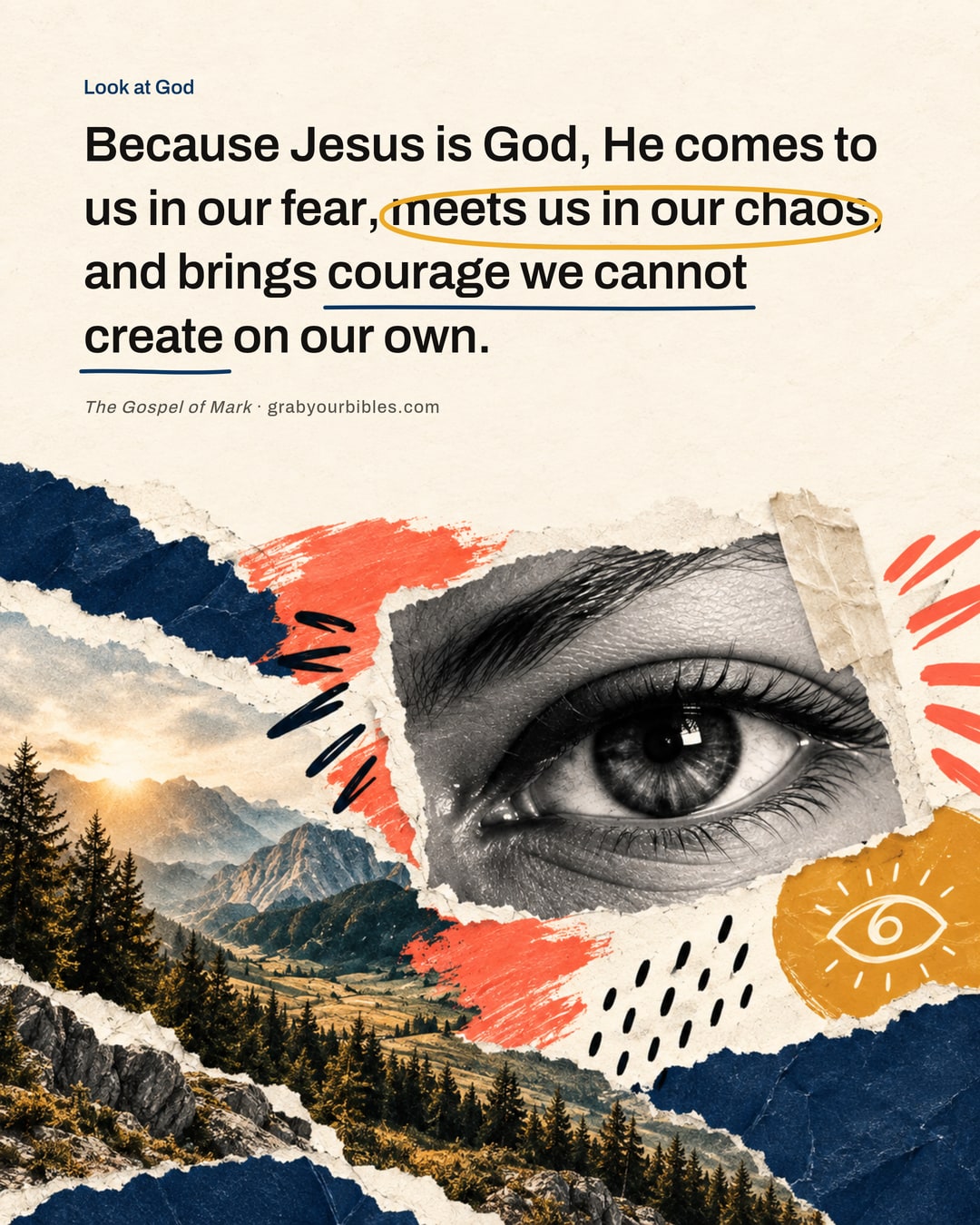
Because Jesus is God, He comes to us in our fear, meets us in our chaos, and brings courage we cannot create on our own.