
Before you start · for whoever is leading
“What actually happened on that mountain, and why does it come right after Peter gets the answer right?”
Peter has just called Jesus the Messiah, and Jesus has immediately told them that being Messiah means suffering and dying, which is not what any of them expected. Six days later three of them see Him for a moment as He really is, and the Father says what He said at the baptism with one thing added: listen to Him. It is God confirming what Peter got right and correcting what he got wrong, in one scene.
A blind man is healed in two goes. First shapes, then faces.
And then, right after that, Jesus asks the question the whole Gospel has been building toward.
Read these stories together because Mark places them side by side.
Mark 8:22-30 | Mark 9:2-8
Tap a tool, then tap words. Highlight what gets your attention · underline what God is doing or saying · circle a repeated or unfamiliar word.
Read it aloud, then give everyone two minutes to mark it in silence.
Read these passages slowly. Notice how Jesus opens eyes, physically in one story, spiritually in the next. What details stand out? How do these moments reveal who God is?
Circle every question mark.
Mark 8:22-30
22
23
24
25
26
27
28
29
30
Mark 9:2-8
2
3
4
5
6
7
8
Mark 8:22-30
22
23
24
25
26
27
28
29
30
Mark 9:2-8
2
3
4
5
6
7
8
NET Scripture quoted by permission. Quotations designated (NET) are from the NET Bible® copyright ©1996, 2019 by Biblical Studies Press, L.L.C. netbible.com
What stood out?
Go around the room. Each person reads one thing they marked. If you know why it stood out, say so. If you don’t, “it just stood out” is a complete answer. Nobody explains, nobody corrects.
Your markings are saved on this device and will be here when you come back.
Who do you say I am?
In Mark 8, Jesus heals a blind man in two stages (8:22-26). At first, the man sees shapes and shadows, then he sees clearly. This is more than a miracle: it is a picture of how God opens spiritual sight. Sometimes we see a little. Sometimes we see slowly. But Jesus is patient as clarity comes.
Immediately after this, Jesus asks the most important question in the Gospel: “Who do you say I am?” (8:29). Peter answers, “You are the Messiah.” It is a breakthrough moment, yet Jesus knows the disciples still do not fully understand what this means. Their expectations of power, success, and glory do not match the identity of a Messiah who will suffer, serve, and give His life.
Jesus invites us to bring Him the places where our vision is blurry: our questions, confusions, assumptions, and fears. He invites us to see Him clearly and to see ourselves in His light. He invites us to stop defining ourselves through comparison, pressure, or performance, and instead to root our identity in who He is. His invitation is simple: look at Me and let clarity come.
Read this one out loud.
Discussion questions
- Where in your life does your “vision” of Jesus feel confusing, incomplete, or uncertain?
- How would you answer if Jesus asked you, “Who do you say I am?” Who has He been in your life, and how do you hope He will meet you in the future?
- In what ways does seeing Jesus help you see yourself more truthfully?
Write it out.
Write freely. Your words are saved in this browser only, on this device, as you type. Nothing you write is sent to us.
Email opens your mail app. We do not store your notes.
Let’s pray together
Read Mark 8:29 and Mark 9:7 aloud again, slowly.
Pray together: “Come, Holy Spirit. Open our eyes to see Jesus clearly.”
In pairs or small clusters, pray for:
- Clarity where someone feels confused, overwhelmed, or unsure
- Healing in identity, in places shaped by comparison or pressure
- Freedom from false stories we tell ourselves
- A deeper revelation of who Jesus is
Leave space for silence, listening, and Spirit-led prayer. If someone senses a word, a Scripture, or a picture for another, offer it gently and pray into it.
Let’s pray
Breakthrough is when God’s Kingdom breaks into your reality: His healing where there is pain, His freedom where there is bondage, His presence where there is loneliness. Jesus is King; His freedom, peace and purpose are available now. Pray from that Kingdom, not toward it.
Be still for a moment. Open your hands and simply pray: “Come, Holy Spirit.”
Ask: “Father, who do I actually say you are, when nobody is listening?” Then: “What were you highlighting when I marked the passage?” Stay open to a word, a Scripture, a picture, or a prompting.
Pray boldly into what He shows you. Ask for the second touch, not just the first.
You can pray more than once. Stay present, and trust that God is at work. Take your time; there is no hurry.
Choose one. Say it out loud so someone else hears it.
Next time you gather, share what you practiced and how God used it, not for pressure but for encouragement.
The reminder downloads as a calendar event. Open it and it lands on your calendar for tomorrow morning.
Back into the passage
You have the teaching now. Go back with it, on your own this week or right now:
For this session
Jesus calls for spiritual sight. God helps us see what is truly real.
Jesus invites personal acknowledgment of His divinity. Our lives change when we see Jesus clearly.
The Father again reveals Jesus’ divine identity. God’s voice centers our lives around His Son.
Jesus declares divine possibility. God meets us where faith feels small and lifts us up.
Jesus reveals the unseen spiritual world. God invites us into dependence, not self-reliance.
Done.
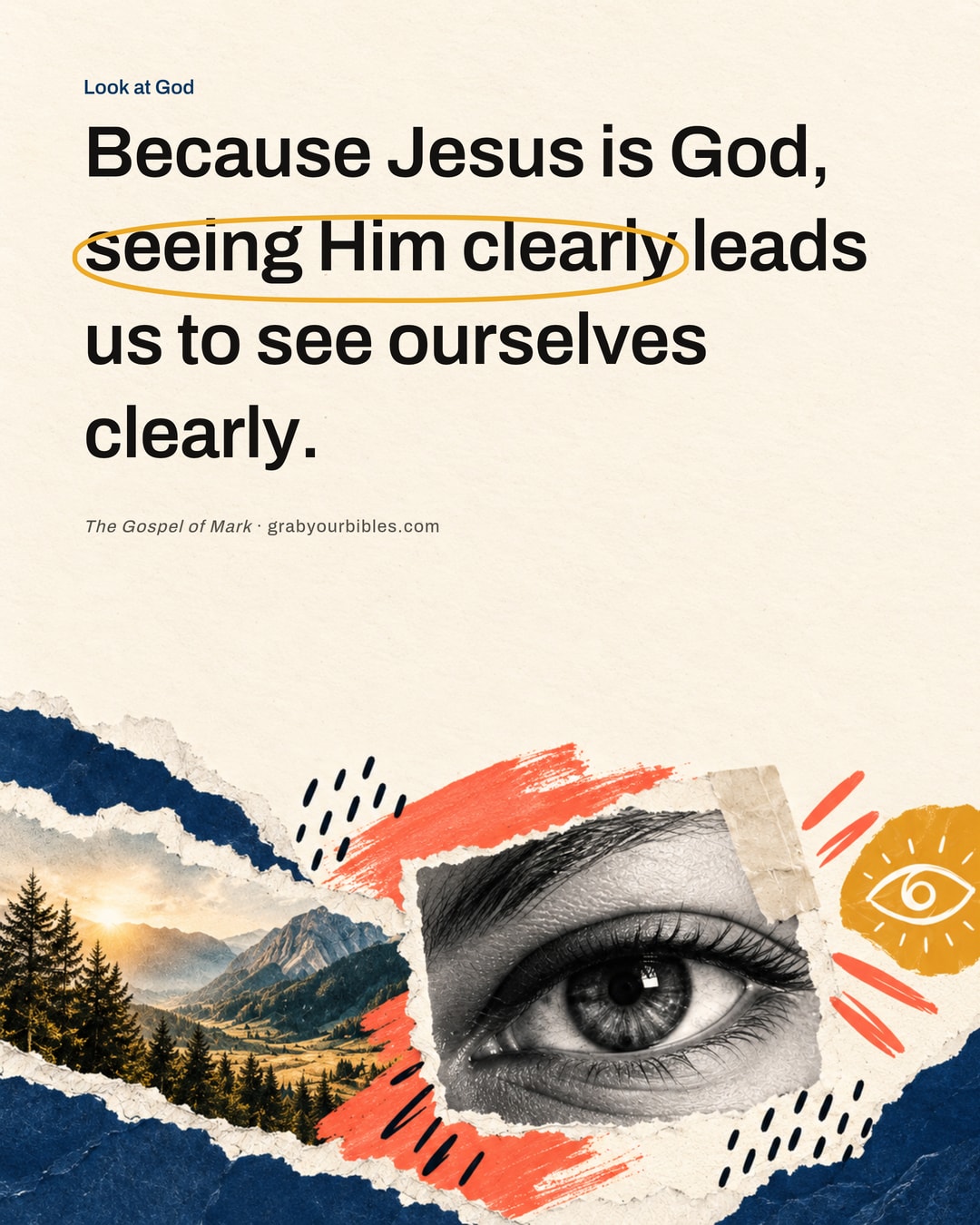
Because Jesus is God, seeing Him clearly leads us to see ourselves clearly.