
First a story about seed and dirt, told to a crowd and explained to the few who stay behind and ask.
Then night falls, and the boat starts taking on water.
Two scenes, back to back. Watch who is listening in each one.
Mark 4:1-20 | Mark 4:26-29 | Mark 4:35-41
Tap a tool, then tap words. Highlight what gets your attention · underline what God is doing or saying · circle a repeated or unfamiliar word.
Read it aloud, then give everyone two minutes to mark it in silence.
Read these passages slowly. Notice what Jesus says about the hidden, steady work of God and how He reveals His authority in the storm. What stands out? What surprises you? What does this show you about who God is?
Circle every question mark.
Mark 4:1-20
1
2
3
4
5
6
7
8
9
10
11
12
13
14
15
16
17
18
19
20
Mark 4:26-29
26
27
28
29
Mark 4:35-41
35
36
37
38
39
40
41
Mark 4:1-20
1
2
3
4
5
6
7
8
9
10
11
12
13
14
15
16
17
18
19
20
Mark 4:26-29
26
27
28
29
Mark 4:35-41
35
36
37
38
39
40
41
Read Mark 4:1-20; Mark 4:26-29; Mark 4:35-41 in the New Living Translation
Mark 4:1-20
Mark 4:26-29
Mark 4:35-41
NET Scripture quoted by permission. Quotations designated (NET) are from the NET Bible® copyright ©1996, 2019 by Biblical Studies Press, L.L.C. netbible.com
What stood out?
Go around the room. Each person reads one thing they marked. If you know why it stood out, say so. If you don’t, “it just stood out” is a complete answer. Nobody explains, nobody corrects.
Your markings are saved on this device and will be here when you come back.
Even the wind and waves obey Him.
Jesus teaches that the Kingdom of God grows like a seed hidden in soil, slowly, steadily, and silently (4:1-20, 26-29). We cannot force it, accelerate it, or always see it. Yet God is at work beneath the surface. His timing is different from ours, and His pace is not hurried or pressured. This is part of His character: God works deeply, patiently, and faithfully.
Then the storm hits. The disciples panic while Jesus sleeps. When they wake Him, He stands and speaks, “Quiet! Be still!” (4:39). The wind and waves obey Him. This echoes Psalm 107, where Yahweh alone calms storms with His voice. The disciples ask, “Who is this?” (4:41). Mark wants us to see the answer clearly: This is God.
In Mark 5, this continues. Jesus drives out a legion of demons with a word (5:1-20). He restores a woman who has suffered for twelve years, not only healing her body but naming her “Daughter” (5:34). Then He raises Jairus’ daughter by command alone: “Little girl, I say to you, get up!” (5:41). Prophets prayed for God to raise the dead. Jesus raises by speaking.
Across these chapters, we see a God who moves with both tenderness and power, a God who calms chaos, confronts darkness, restores identity, and brings life where despair has settled. He works slowly in the soil and suddenly in the storm. But He is always working.
Jesus invites us to trust Him when life feels slow, uncertain, or out of control. He invites us to stop assuming that silence means absence or that storms mean abandonment. He invites us to rest in His presence, even when His pace does not match our expectations. His invitation is simple: let Me grow what you cannot rush and let Me speak peace into what feels overwhelming.
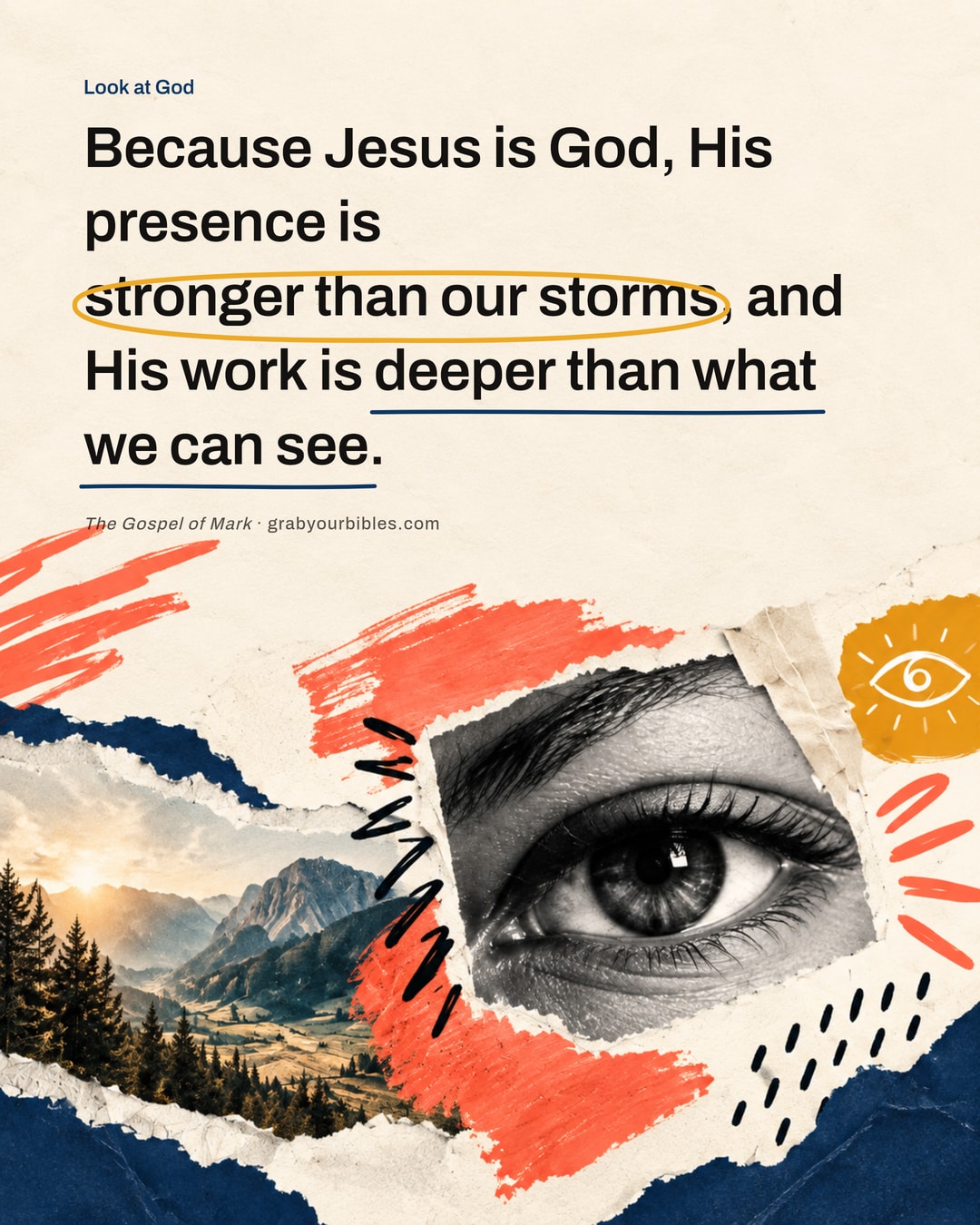
Read this one out loud.
Discussion questions
- Where in your life does God feel slow or hidden right now?
- What does Jesus calming the storm teach you about God’s presence in your anxiety or chaos?
- How is Jesus inviting you to trust His pace or His presence this week?
Write it out.
Write freely. Your words are saved in this browser only, on this device, as you type. Nothing you write is sent to us.
Email opens your mail app. We do not store your notes.
Let’s pray together
Read Mark 4:39-41 aloud again, slowly.
Pray together: “Come, Holy Spirit. Speak peace to our storms.”
In pairs or small clusters, pray for:
- Peace in anxious or overwhelming places
- Strength for waiting seasons
- Healing in hidden or long-term struggles
- Awareness of Jesus’ presence in uncertainty
Leave space for silence, listening, and Spirit-led prayer. If someone senses a word, a Scripture, or a picture for another, offer it gently and pray into it.
Let’s pray
Breakthrough is when God’s Kingdom breaks into your reality: His healing where there is pain, His freedom where there is bondage, His presence where there is loneliness. Jesus is King; His freedom, peace and purpose are available now. Pray from that Kingdom, not toward it.
Be still for a moment. Open your hands and simply pray: “Come, Holy Spirit.”
Ask: “Father, where have I read your silence as your absence?” Then: “What were you highlighting when I marked the passage?” Stay open to a word, a Scripture, a picture, or a prompting.
Pray boldly into what He shows you. Ask Him to speak to the storm before you ask Him to end it.
You can pray more than once. Stay present, and trust that God is at work. Take your time; there is no hurry.
Choose one. Say it out loud so someone else hears it.
Next time you gather, share what you practiced and how God used it, not for pressure but for encouragement.
The reminder downloads as a calendar event. Open it and it lands on your calendar for tomorrow morning.
Back into the passage
You have the teaching now. Go back with it, on your own this week or right now:
For this session
Jesus speaks with prophetic and divine authority. God invites us to listen and respond to His voice.
Jesus calls for trust in His divine presence. God is with us even when circumstances feel overwhelming.
Jesus calms creation with Yahweh’s authority from Psalm 107. God speaks peace into our chaos and anxiety.
Jesus commands the natural world. God’s power is present in the storms of our lives.
Jesus commands the demonic with total authority. God frees us from the forces that seek to hold us down.
Jesus heals with compassion and identity-restoring love. God sees our pain and brings wholeness.
Jesus raises the dead by His word alone. God brings life into our hopeless places.
Done.
Because Jesus is God, His presence is stronger than our storms, and His work is deeper than what we can see.