
Galatians 5:22-23 | John 15:9-13
Tap a tool, then tap words. Highlight what gets your attention · underline what God is doing or saying · circle a repeated or unfamiliar word.
Read it aloud, then give everyone two minutes to mark it in silence.
Notice what Jesus measures His love by, and what He asks you to remain in.
Galatians 5:22-23
22
23
John 15:9-13
9
10
11
12
13
Galatians 5:22-23
22
23
John 15:9-13
9
10
11
12
13
NET Scripture quoted by permission. Quotations designated (NET) are from the NET Bible® copyright ©1996, 2019 by Biblical Studies Press, L.L.C. netbible.com
What stood out?
Go around the room. Each person reads one thing they marked. If you know why it stood out, say so. If you don’t, “it just stood out” is a complete answer. Nobody explains, nobody corrects.
Your markings are saved on this device and will be here when you come back.
Love
“And now these three remain: faith, hope, and love. But the greatest of these is love.” (1 Corinthians 13:13)
“As the Father has loved me, so have I loved you. Now remain in my love.” (John 15:9)
Love (agapē) is not one fruit among many, it’s the root from which all the others grow. Every fruit of the Spirit is love in a different form:
Joy is love celebrating.
Peace is love resting.
Patience is love enduring.
Kindness and goodness are love serving.
Faithfulness is love staying.
Gentleness is love yielding.
Self-control is love choosing.
God’s love is not a feeling; it’s His very nature; the creative energy that made the world and the redemptive power that renews it. The Spirit doesn’t just help us feel love; He forms us into love until our lives begin to look like Jesus.
God’s love is not abstract or sentimental, it’s demonstrated. “God demonstrates his own love for us in this: While we were still sinners, Christ died for us.” (Romans 5:8) The cross is not just proof of God’s love; it’s the definition of it. Every other “sign” we seek (answered prayers, success, or comfort) will fall short if we measure love by ease instead of by Calvary.
If we look for God’s love in what we lack, we’ll miss what He’s already given. The cross silences every question about whether we’re loved: because there, in our sin and separation, Jesus joined us.
Love is God’s decision to move toward us when we were furthest from Him, to embrace us not after we changed, but in order to change us. That same love now lives in us through His Spirit, teaching us to move toward others with the same grace.
To remain in love is to remain in this story: the story where love goes first, gives everything, and never leaves.
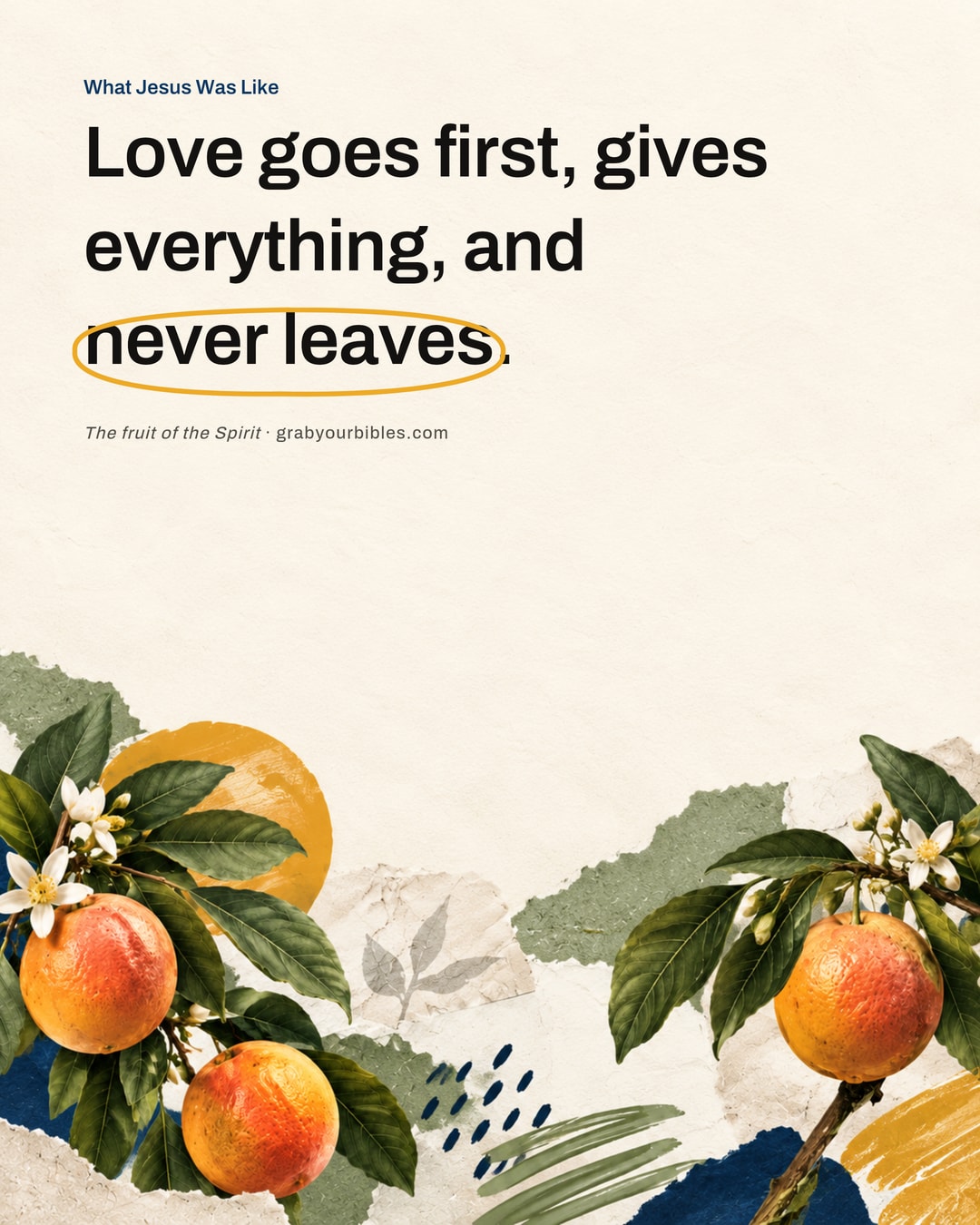
Read this one out loud.
Discussion questions
- Take a moment to pause and remember how God has loved you, not when you were perfect, but when you were still far off.
- Read Romans 5:8 slowly: “While we were still sinners, Christ died for us.”
Write it out.
Write freely. Your words are saved in this browser only, on this device, as you type. Nothing you write is sent to us.
Email opens your mail app. We do not store your notes.
Choose one. Say it out loud so someone else hears it.
Next time you gather, share what you practiced and how God used it, not for pressure but for encouragement.
The reminder downloads as a calendar event. Open it and it lands on your calendar for tomorrow morning.
Back into the passage
You have the teaching now. Go back with it, on your own this week or right now:
For this session
God’s self-giving love revealed at the cross; the root of every other fruit. Agapē is not emotion but decision; God’s will to seek the good of another, even at great cost. It is covenant love: self-sacrificing, initiating, and enduring. Every other fruit of the Spirit is love expressed in a different form.
“For God so loved the world that He gave His one and only Son.”
“While we were still sinners, Christ died for us.”
“This is love: not that we loved God, but that He loved us.”
The shape of love lived out.
Love goes first, gives everything, and never leaves. It is both the seed and the harvest of a Spirit-filled life.
Done.
Love goes first, gives everything, and never leaves.