
A man asks a question he already knows the answer to, and then asks a second one to get himself off the hook.
Jesus answers with a story about a road.
Read it, and count how many people see the man in the ditch.
Galatians 5:22-23 | Luke 10:25-37
Tap a tool, then tap words. Highlight what gets your attention · underline what God is doing or saying · circle a repeated or unfamiliar word.
Read it aloud, then give everyone two minutes to mark it in silence.
Notice who is asking, what he is really asking, and what each person on the road does.
And one more, every session of this study: mark the moment where something is being asked of Jesus and the result is not there yet.
Galatians 5:22-23
22
23
Luke 10:25-37
25
26
27
28
29
30
31
32
33
34
35
36
37
Galatians 5:22-23
22
23
Luke 10:25-37
25
26
27
28
29
30
31
32
33
34
35
36
37
NET Scripture quoted by permission. Quotations designated (NET) are from the NET Bible® copyright ©1996, 2019 by Biblical Studies Press, L.L.C. netbible.com
What stood out?
Go around the room. Each person reads one thing they marked. If you know why it stood out, say so. If you don’t, “it just stood out” is a complete answer. Nobody explains, nobody corrects.
Your markings are saved on this device and will be here when you come back.
Kindness + Goodness
In Paul’s list, kindness (chrēstotēs) and goodness (agathōsynē) appear side by side because they describe two sides of the same reality: God’s character expressed in action.
Kindness is compassionate generosity, a tenderness that meets real needs.
Goodness is moral integrity, the courage to do what is right and life-giving.
Together, they show us what love looks like when it moves.
Throughout Scripture, God’s kindness and goodness are active, not abstract. He feeds the hungry, lifts the poor, forgives the sinner, and keeps reaching out to heal the world. In Jesus, that kindness took on skin. He touched lepers, welcomed outsiders, and restored what was broken.
In the parable of the Good Samaritan, Jesus describes that same love in motion. The Samaritan doesn’t analyze or delay, He stops, bandages wounds, and gives his resources. Kindness sees, goodness acts.
The Spirit cultivates this fruit in us so that compassion becomes courage: our hearts see, and our hands move.
“Go and do likewise.” (Luke 10:37)
The point of the story was an invitation, not just observation! Jesus isn’t just asking us to admire the Samaritan’s compassion, He’s calling us to embody it. To see people the way He does: with eyes open, hearts ready, and hands willing to move toward need. Genuine kindness doesn’t wait for applause or convenience; it simply responds in love, joining God’s work of restoration in the world.
Kindness and goodness grow as we train our eyes to see and our hearts to respond. The Spirit teaches us to notice need and move toward it, not out of guilt, but out of love.
1. We See and Stop (Luke 10:33) We pay attention to what gets our attention. When interruptions come, we treat them as invitations. Sometimes love looks like an inconvenient detour to care for someone in need.
2. We Give Without Return (Matthew 6:1-4) We give our time, skills, or resources without seeking credit or the spotlight. Let your kindness stay between you and God. Quiet goodness has power the world can’t measure.
3. We overcome evil with Good (Romans 12:21) Goodness doesn’t just avoid harm; it restores what’s been lost. We show up where life has grown dim (a weary friend, a broken habit, a neglected space) and bring good there again. Ask the Spirit how you can overcome discouragement with hope and evil with good.
Read this one out loud.
Discussion questions
- Where do you notice people or needs that others overlook?
- How does the Good Samaritan challenge your idea of “neighbor”?
- Which practice (seeing and stopping, giving without return, or bringing life where things feel empty) stirs something in you?
Write it out.
Write freely. Your words are saved in this browser only, on this device, as you type. Nothing you write is sent to us.
Email opens your mail app. We do not store your notes.
Let’s pray together
Kindness and goodness flow when the Spirit opens our eyes to see what God sees. “Jesus, open our eyes to the needs around us. Make us people who stop, not pass by. Fill us with Your kindness that sees, moves, and heals.”
Read Luke 10:33-37 slowly. Hear Jesus say, “Go and do likewise.” Invite the Spirit to show one concrete way to bring His goodness into your world.
Leave space for silence, listening, and Spirit-led prayer. If someone senses a word, a Scripture, or a picture for another, offer it gently and pray into it.
Let’s pray
Breakthrough is when God’s Kingdom breaks into your reality: His healing where there is pain, His freedom where there is bondage, His presence where there is loneliness. Jesus is King; His freedom, peace and purpose are available now. Pray from that Kingdom, not toward it.
Be still for a moment. Open your hands and simply pray: “Come, Holy Spirit.”
Pray: “Jesus, open my eyes to the needs around me. Make me someone who stops, not passes by. Fill me with Your kindness that sees, moves, and heals.” Then read Luke 10:33-37 slowly. Hear Jesus say, “Go and do likewise.” Invite the Spirit to show one concrete way to bring His goodness into your world.
You can pray more than once. Stay present, and trust that God is at work. Take your time; there is no hurry.
Choose one. Say it out loud so someone else hears it.
Next time you gather, share what you practiced and how God used it, not for pressure but for encouragement.
The reminder downloads as a calendar event. Open it and it lands on your calendar for tomorrow morning.
Back into the passage
You have the teaching now. Go back with it, on your own this week or right now:
For this session
Compassionate generosity (chrēstotēs) and moral integrity (agathōsynē) in action. These two words appear together throughout Paul’s letters. Chrēstotēs emphasizes tenderhearted benevolence; love that notices and helps. Agathōsynē adds moral courage: doing what’s right even when costly. Together they picture God’s goodness moving toward need.
“God’s kindness leads you to repentance.” (chrēstotēs)
“Let us do good to all people.” (agathōsynē)
God shows “the immeasurable riches of his grace in kindness toward us in Christ Jesus.”
Kindness sees; goodness acts. When the Spirit fills us, compassion becomes courage and love becomes movement.
Done.
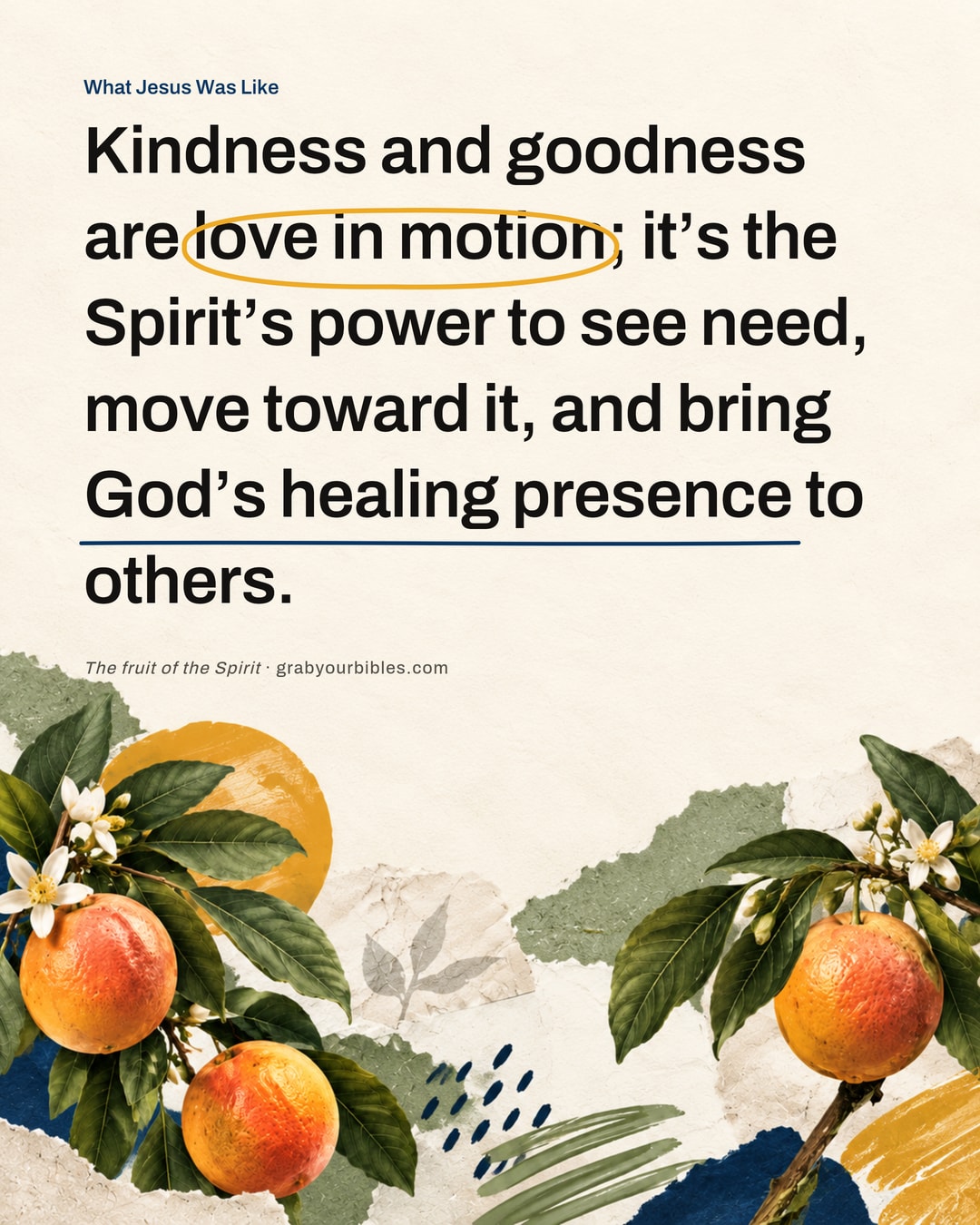
Kindness and goodness are love in motion; it’s the Spirit’s power to see need, move toward it, and bring God’s healing presence to others.