
Forty days without food, and the first thing offered to Him is bread.
He does not argue about whether He is hungry.
He answers with one line from somewhere else. Read what that line says He lives on.
Galatians 5:22-23 | Luke 4:1-13
Tap a tool, then tap words. Highlight what gets your attention · underline what God is doing or saying · circle a repeated or unfamiliar word.
Read it aloud, then give everyone two minutes to mark it in silence.
Notice what is offered to Him, what He answers with, and what He never once defends.
And one more, every session of this study: mark the moment where something is being asked of Jesus and the result is not there yet.
Galatians 5:22-23
22
23
Luke 4:1-13
1
2
3
4
5
6
7
8
9
10
11
12
13
Galatians 5:22-23
22
23
Luke 4:1-13
1
2
3
4
5
6
7
8
9
10
11
12
13
NET Scripture quoted by permission. Quotations designated (NET) are from the NET Bible® copyright ©1996, 2019 by Biblical Studies Press, L.L.C. netbible.com
What stood out?
Go around the room. Each person reads one thing they marked. If you know why it stood out, say so. If you don’t, “it just stood out” is a complete answer. Nobody explains, nobody corrects.
Your markings are saved on this device and will be here when you come back.
Self-Control
The Spirit led Jesus into the wilderness, not to prove His strength but to reveal His trust. Before temptation came, He had already received His Father’s voice: “You are My beloved Son.” That affirmation became His anchor when every lie offered another identity.
Self-control (enkrateia in the Bible’s original language) means “strength from within.” It’s the Spirit’s gift that allows us to master our desires instead of being mastered by them. It’s the Spirit’s power to align our desires with God’s will.
In the wilderness, Jesus shows that true power is the ability to say ’no’ to what tempts us away from God’s best. He resists temptation not through willpower or repression but through trust and dependence, relying on the Father’s word and timing. Jesus models keeping in step with the Spirit; His ’no’ is empowered by a deeper ’yes’ to the Father.
When the Spirit fills us, He realigns our loves so that obedience becomes joy, not duty. He transforms our instincts, replacing self-centered impulses with self-giving love.
Jesus invites us into the freedom of dependence; to discover life that isn’t ruled by appetite but by love. Self-control grows from hearing God’s voice as the Spirit shapes our desires into joyful obedience.
“Man shall not live on bread alone, but on every word that comes from the mouth of God.” (Matthew 4:4)
Self-control grows before the wilderness, in daily rhythms of hearing and trusting God’s voice. These short practices open space for the Spirit to shape desire.
1. We practice hearing God’s Voice (Luke 3:22) Begin with Scripture before screens each morning. Read slowly until a word or phrase stands out. Let the Spirit remind you who you are, God’s beloved.
2. We Pray God’s Words (Luke 4:4) When stress, distraction, or desire pulls, we speak truth out loud: “Father, help me to live by Your word today.” Let Scripture reshape your inner dialogue.
3. We Rest in God’s Presence (Psalm 46:10) Spend five quiet minutes a day simply being with God. We don’t strive or analyze; let His love become the loudest voice in our hearts.
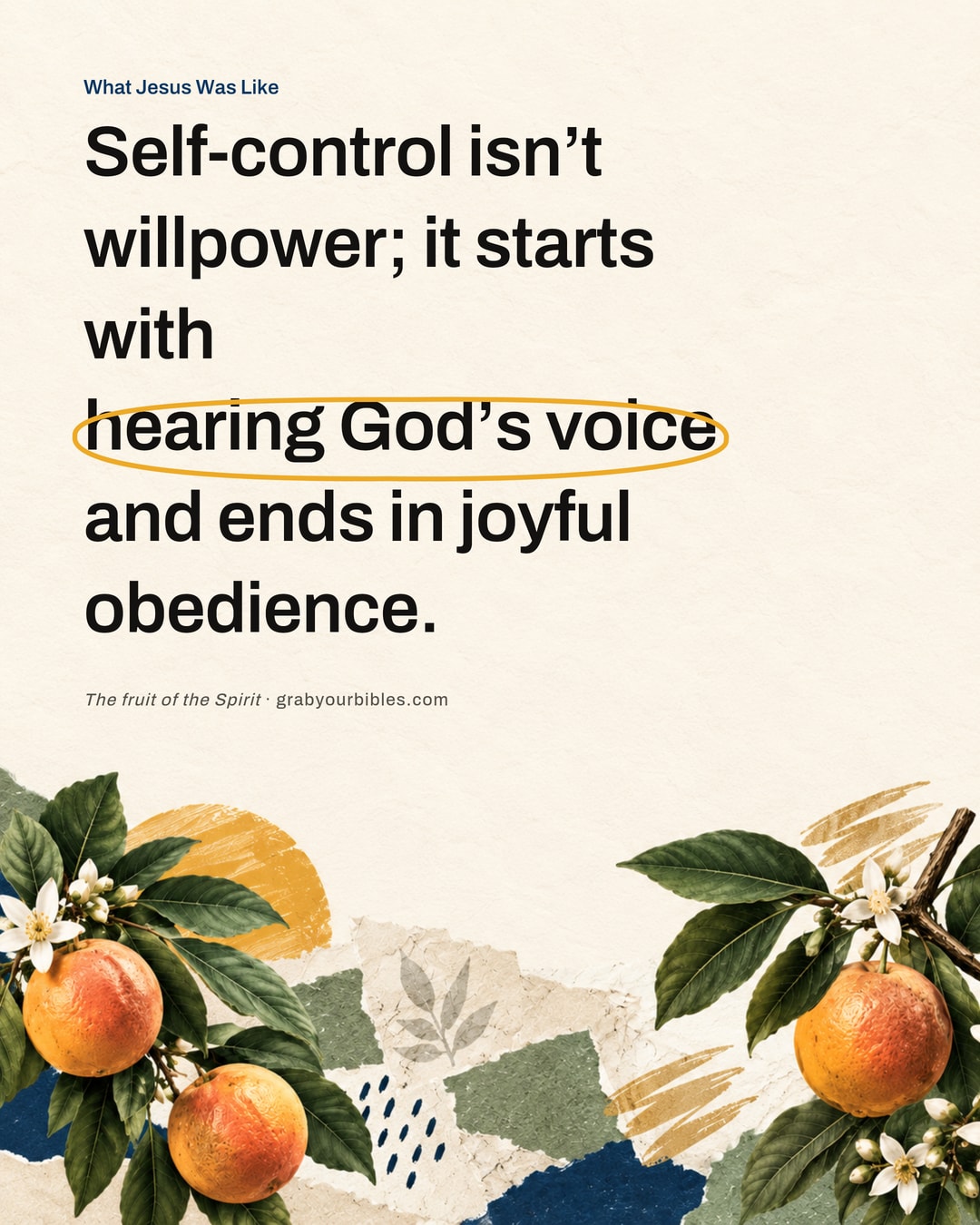
Read this one out loud.
Discussion questions
- What voices or desires most often compete with God’s voice in your daily life?
- How does knowing that Jesus’ self-control flowed from the Father’s love, not from raw willpower, change the way you think about obedience?
- Of the three practices (hearing God’s voice, praying His words, and resting in His presence) which one feels most needed in your life right now, and when will you make space for it?
Write it out.
Write freely. Your words are saved in this browser only, on this device, as you type. Nothing you write is sent to us.
Email opens your mail app. We do not store your notes.
Let’s pray together
We don’t overcome temptation by trying harder but by depending more deeply on the Spirit. This is a moment to surrender, to invite God’s strength where your own runs out.
1. Take a few quiet moments to identify where you most need the Spirit’s help this week.
2. Hold that situation before God and pray: “Holy Spirit, be our strength where we are weak. Teach us to depend on Your power, not our own effort.”
3. Listen for what the Spirit might be saying to you, a word, a verse, a reminder of truth. If you feel led, speak that encouragement or Scripture over someone else in the group.
Leave space for silence, listening, and Spirit-led prayer. If someone senses a word, a Scripture, or a picture for another, offer it gently and pray into it.
Let’s pray
Breakthrough is when God’s Kingdom breaks into your reality: His healing where there is pain, His freedom where there is bondage, His presence where there is loneliness. Jesus is King; His freedom, peace and purpose are available now. Pray from that Kingdom, not toward it.
Be still for a moment. Open your hands and simply pray: “Come, Holy Spirit.”
1. Take a few quiet moments to identify where you most need the Spirit’s help this week. 2. Hold that situation before God and pray: “Holy Spirit, be my strength where I am weak. Teach me to depend on Your power, not my own effort.” 3. Listen for what the Spirit might be saying, a word, a verse, a reminder of truth. Write it down. If it is for somebody else, send it to them this week.
You can pray more than once. Stay present, and trust that God is at work. Take your time; there is no hurry.
Choose one. Say it out loud so someone else hears it.
Next time you gather, share what you practiced and how God used it, not for pressure but for encouragement.
The reminder downloads as a calendar event. Open it and it lands on your calendar for tomorrow morning.
Back into the passage
You have the teaching now. Go back with it, on your own this week or right now:
For this session
Spirit-given inner strength that aligns desire with God’s will. Enkrateia literally means “strength from within.” It’s not willpower or repression but Spirit-formed mastery over impulse and appetite. In the Greek world, it implied discipline or self-mastery; in the New Testament, it’s redefined as dependence; the Spirit empowering us to live freely within God’s design.
Paul reasons with Felix “about righteousness, self-control, and the coming judgment.”
“Everyone who competes in the games exercises self-control in all things.”
“Add to knowledge self-control; and to self-control, perseverance.”
Self-control isn’t a momentary decision but a daily alignment of the heart. We become truly free when our desires agree with God’s desires.
Done.
Self-control isn’t willpower; it starts with hearing God’s voice and ends in joyful obedience.