
Before you start · for whoever is leading
Somebody will say that the earth has been given to us means we can use it however we like.
Genesis 2:15 says the man was put in the garden to work it and to take care of it, and those are two different jobs in Hebrew as well as in English: taking care of something is not the same as owning it.
Romans 8:21 says creation is waiting to be set free rather than used up, so if the earth is going to be renewed instead of discarded, how we treat it now is practice rather than waste.
“We are not God. The earth was here before us and it has been given to us.”
Paul says creation is waiting, and he says it is waiting for people.
Read who he says creation is waiting on, and what it was subjected to.
Then read one verse in Genesis and notice the two jobs the man is given.
Romans 8:18-25 | Genesis 2:15 · NIV
Tap a tool, then tap words. Highlight what gets your attention · underline what God is doing or saying · circle a repeated or unfamiliar word.
Read it aloud, then give everyone two minutes to mark it in silence.
Romans 8:18-25
18
19
20
21
22
23
24
25
Genesis 2:15
15
NIV The Holy Bible, New International Version®, NIV® Copyright ©1973, 1978, 1984, 2011 by Biblica, Inc.® Used by permission. All rights reserved worldwide. www.biblica.com
What stood out?
Go around the room. Each person reads one thing they marked. If you know why it stood out, say so. If you don’t, “it just stood out” is a complete answer. Nobody explains, nobody corrects.
Your markings are saved on this device and will be here when you come back.
The Kingdom and Creation
Creation itself is groaning for the full revelation of God’s Kingdom. God’s Kingdom involves the restoration of all things, including the natural world, and we are called to care for creation as part of our Kingdom mission.
God gave humanity the mandate to “rule” over creation (Genesis 1:28), not as harsh dominators, but as caretakers who reflect His loving stewardship. The Hebrew verb for “work” in Genesis 2:15, ‘abad’, can mean work or serve, and elsewhere it is also used for priestly service. That is one reason many readers see humanity’s work in the garden as more than ordinary labor: it carries a sacred vocation. Just as we find joy in experiencing nature, we are called to partner with God in caring for it, reflecting the hope of a renewed world through our stewardship and daily choices.
- The Kingdom of God is about the renewal of all things, including the natural world.
- Creation’s groaning reflects the brokenness of the world and the hope of renewal/restoration.
- As Kingdom people, we are called to steward creation well and anticipate the day when all things will be made new.
Read this one out loud.
Discussion questions
- What’s your favorite way to enjoy nature, and how does it make you feel connected to God?
- Have you ever felt a responsibility to take better care of something in your life? What was it?
- What’s one practical way you can be more mindful of God’s creation this week?
Write it out.
Write freely. Your words are saved in this browser only, on this device, as you type. Nothing you write is sent to us.
Email opens your mail app. We do not store your notes.
Let’s pray together
- Where do you see brokenness in creation, and how can we partner with God in restoration? How can we encourage each other to take practical steps?
Leave space for silence, listening, and Spirit-led prayer. If someone senses a word, a Scripture, or a picture for another, offer it gently and pray into it.
Let’s pray
Breakthrough is when God's Kingdom breaks into your reality: His healing where there is pain, His freedom where there is bondage, His presence where there is loneliness. Jesus is King; His freedom, peace and purpose are available now. Pray from that Kingdom, not toward it.
Be still for a moment. Open your hands and simply pray: “Come, Holy Spirit.”
Ask: “What do You want me to know right now? What were You highlighting when I marked the passage?” Stay open to a word, a Scripture, a picture, or a prompting.
Pray boldly into what He shows you. Ask for His Kingdom in the specific places this session touched:
- Where do you see brokenness in creation? Write down one place. Then pray about one practical step, and tell one person that you are taking it.
You can pray more than once. Stay present, and trust that God is at work. Take your time; there is no hurry.
Choose one. Say it out loud so someone else hears it.
Next time you gather, share what you practiced and how God used it, not for pressure but for encouragement.
The reminder downloads as a calendar event. Open it and it lands on your calendar for tomorrow morning.
Done.
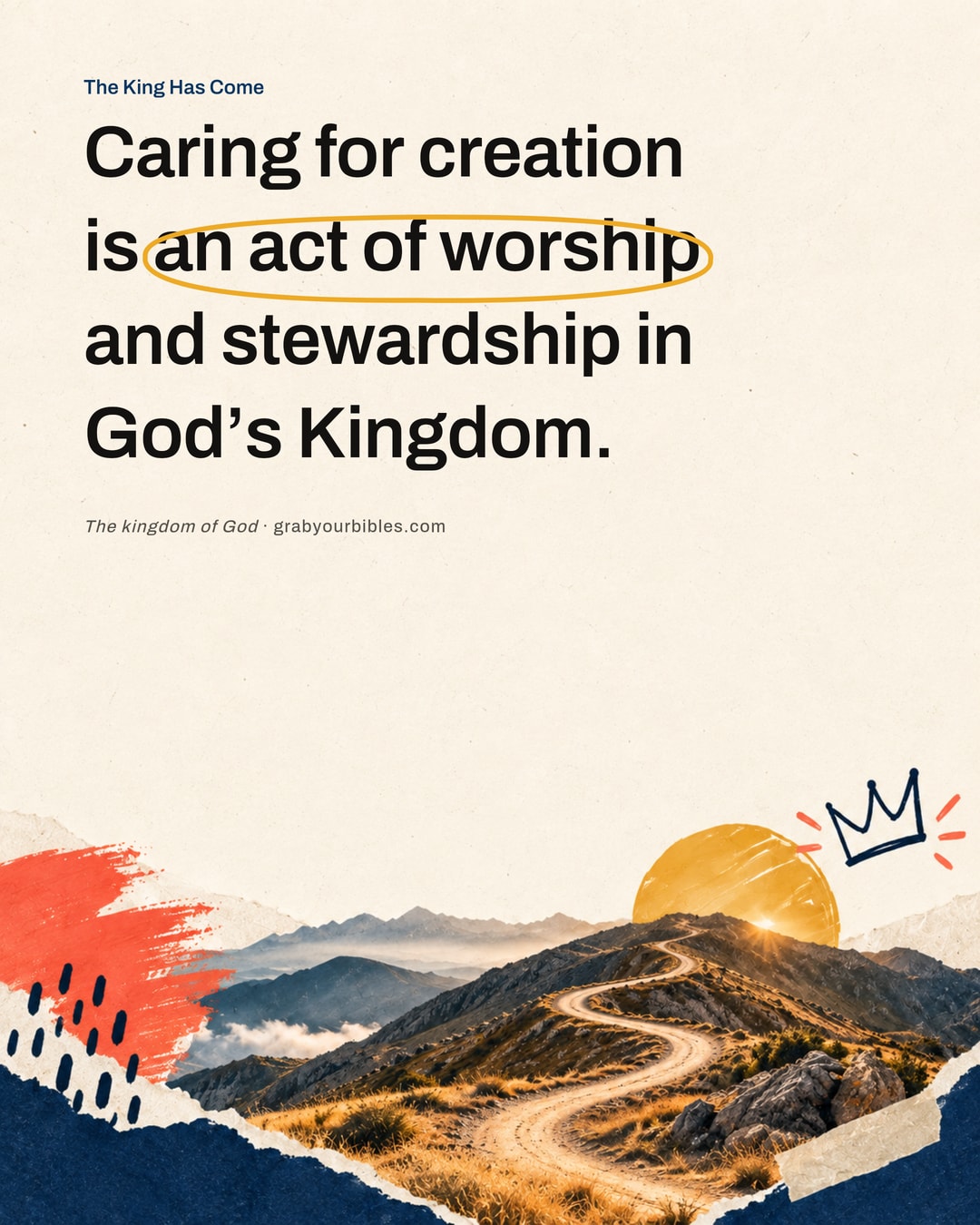
Caring for creation is an act of worship and stewardship in God’s Kingdom.