
Before you start · for whoever is leading
The room will press the apparent contradiction. Paul uses two different words and you can see the difference in the English: verse 2 is a weight that would crush one person, verse 5 is the pack everyone is expected to carry. So the rule is not help with everything, and it is not handle it yourself. It is help with what would crush someone, and do not take over what is theirs to carry.
Verse 2 says carry each other’s burdens.
Verse 5 says each of you should carry your own load.
Read both, and notice that Paul does not seem to think he has contradicted himself.
Galatians 6:2-5
Tap a tool, then tap words. Highlight what gets your attention · underline what God is doing or saying · circle a repeated or unfamiliar word.
Read it aloud, then give everyone two minutes to mark it in silence.
Read the passage slowly. Notice the two different things Paul says to carry, and who is supposed to carry each one. What details stand out? What surprises you?
And one more, every session of this study: the house instruction already asks you to underline what God is doing. In this study, also circle what the people are doing.
NET Scripture quoted by permission. Quotations designated (NET) are from the NET Bible® copyright ©1996, 2019 by Biblical Studies Press, L.L.C. netbible.com
What stood out?
Go around the room. Each person reads one thing they marked. If you know why it stood out, say so. If you don’t, “it just stood out” is a complete answer. Nobody explains, nobody corrects.
Your markings are saved on this device and will be here when you come back.
Boundaries and responsibility
One helpful way to read Paul’s distinction is this: burdens are too heavy for one person to carry, and loads are our personal responsibility. Galatians 6 calls us to carry one another’s burdens while also owning our own load. Healthy boundaries allow us to love well without being crushed. They help us say yes and no in ways that honor God and others.
Jesus Himself modeled boundaries. He said yes to the Father’s will, but He also said no to distractions, pressures, and even to people at times (Luke 4:42-44). He lived with clarity about His purpose. Boundaries are not walls to keep people out; they are guardrails that protect love, mission, and presence with God, and keep love in the right place.
Henry Cloud and John Townsend write: “Boundaries define where you end and someone else begins. Every yes must be protected by the freedom to say no.”
Dallas Willard adds: “Grace is not opposed to effort, but to earning.” Boundaries take grace-shaped effort; learning to live freely in God’s love.
Boundaries are about stewardship of what God has entrusted to me: my time, my energy, my relationships. To grow in Christ, we learn to:
Take responsibility for my choices, emotions, and actions.
Ask for help when life is too heavy; carry others in love.
Clarity is kindness. Healthy no’s create room for meaningful yes’s.
My life is God’s temple. Boundaries protect what is sacred: my time, body, soul, and relationships.
Boundaries and responsibility are not about selfishness; they are about becoming safe people who can love, serve, and lead with integrity.
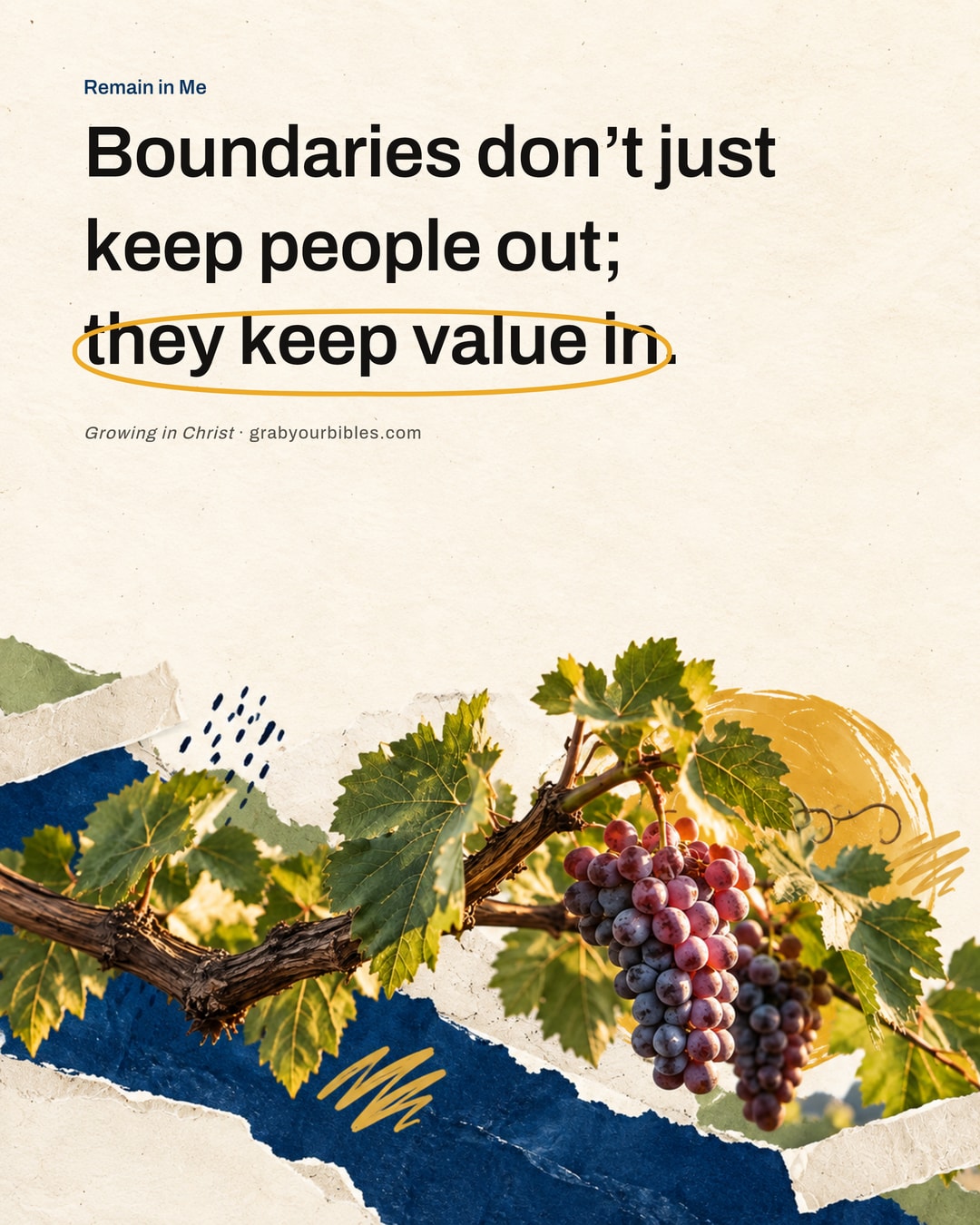
Read this one out loud.
Discussion questions
- What stands out to you in Galatians 6 about carrying burdens and carrying your own load?
- Do you tend to struggle more by avoiding responsibility or by taking on too much?
- Where is God inviting you to practice a healthier yes or no?
- How do clear boundaries make community safer and healthier?
Write it out.
Write freely. Your words are saved in this browser only, on this device, as you type. Nothing you write is sent to us.
Email opens your mail app. We do not store your notes.
Let’s pray together
Read Galatians 6:2-5 aloud again.
Pray together: “Come, Holy Spirit. Teach us to live with wisdom, responsibility, and love.”
In pairs, share one area where you need help carrying a burden, or one place where you need courage to set a boundary.
Pray for: courage to take responsibility for my own load; grace to ask for and give help with heavy burdens; freedom from comparison or people-pleasing.
Leave space for silence, listening, and Spirit-led prayer. If someone senses a word, a Scripture, or a picture for another, offer it gently and pray into it.
Let’s pray
Breakthrough is when God’s Kingdom breaks into your reality: His healing where there is pain, His freedom where there is bondage, His presence where there is loneliness. Jesus is King; His freedom, peace and purpose are available now. Pray from that Kingdom, not toward it.
Be still for a moment. Open your hands and simply pray: “Come, Holy Spirit.”
Read Galatians 6:2-5 aloud again. Pray: “Come, Holy Spirit. Teach me to live with wisdom, responsibility, and love.” Then write down two things: one burden you need help carrying, and one place you need courage to set a boundary. Ask for courage for your own load, grace to ask for help with the heavy one, and freedom from comparison.
Then name one person you could tell about the first thing this week.
You can pray more than once. Stay present, and trust that God is at work. Take your time; there is no hurry.
Choose one. Say it out loud so someone else hears it.
Next time you gather, share what you practiced and how God used it, not for pressure but for encouragement.
The reminder downloads as a calendar event. Open it and it lands on your calendar for tomorrow morning.
Back into the passage
You have the teaching now. Go back with it, on your own this week or right now:
For this session
Let your yes be yes.
Jesus set boundaries to stay on mission.
Your body is God’s temple.
Guard your heart.
Use freedom to serve in love.
Done.
Boundaries don’t just keep people out; they keep value in.