
A branch does not strain to produce grapes.
Read what Jesus says a branch actually has to do, and count how many times He says the same word.
Then read what He says happens apart from Him.
John 15:4-5 | John 15:9-11
Tap a tool, then tap words. Highlight what gets your attention · underline what God is doing or saying · circle a repeated or unfamiliar word.
Read it aloud, then give everyone two minutes to mark it in silence.
Read the passage slowly. Notice the one word He keeps repeating, what He says it produces, and what He says happens without it. What details stand out? What surprises you?
And one more, every session of this study: the house instruction already asks you to underline what God is doing. In this study, also circle what the people are doing.
John 15:4-5
4
5
John 15:9-11
9
10
11
John 15:4-5
4
5
John 15:9-11
9
10
11
NET Scripture quoted by permission. Quotations designated (NET) are from the NET Bible® copyright ©1996, 2019 by Biblical Studies Press, L.L.C. netbible.com
What stood out?
Go around the room. Each person reads one thing they marked. If you know why it stood out, say so. If you don’t, “it just stood out” is a complete answer. Nobody explains, nobody corrects.
Your markings are saved on this device and will be here when you come back.
Abiding through practices
Jesus describes discipleship in terms of abiding: staying rooted in Him like a branch in the vine. We don’t produce fruit by trying harder, but by staying connected to Him. The practices of prayer, Scripture, communion, fasting, and listening to the Spirit are not ways of earning God’s love. They are ways of making ourselves available to the God who already loves us.
Discipleship in the ancient world commonly carried the idea of apprenticing yourself to a teacher and way of life. The same is true for rabbis and their disciples in Jesus’ day. To follow meant to adopt the rhythms, habits, and practices of the teacher.
We cannot be disciples without disciplines. Following Jesus is more than belief; it is a way of life.
Jesus calls us to abide, not achieve. He promises that when we remain in His love, we will bear fruit that lasts. Spiritual disciplines are not legalistic hoops to jump through. They are relational rhythms that keep us near to Him.
Dallas Willard notes, “Grace is not opposed to effort, but to earning. Effort is action; earning is attitude.” Spiritual disciplines are grace-filled efforts, practices that help us cooperate with God’s work in us.
John Mark Comer reminds us: “We are all being formed every day... the question is, into what?” Disciplines are counter-formations against hurry, consumerism, and performance. They root us in our identity as God’s children, and they train us to join God’s mission in the world.
How do we abide? By making space for God to shape us. Disciplines are practices that open us to His presence:
Bringing our lives honestly before God.
Letting God’s Word light our path.
Remembering Christ’s sacrifice and grace.
Training our desires to hunger for God first.
Discerning God’s voice and leading.
Disciplines don’t make God love us more; they make us more open to the God who already loves us. They form us into disciples who live freely, love deeply, and are ready to be sent.
Read this one out loud.
Discussion questions
- What do you notice in Jesus’ image of abiding in the vine in John 15?
- How have you tended to think about spiritual disciplines: as burdens, or as ways to abide?
- Which practice (prayer, Scripture, communion, fasting, listening) feels most natural to you? Which feels hardest?
- How could practicing one of these disciplines help you stay rooted in Jesus this week?
Write it out.
Write freely. Your words are saved in this browser only, on this device, as you type. Nothing you write is sent to us.
Email opens your mail app. We do not store your notes.
Let’s pray together
Read John 15:4-5 aloud again, slowly.
Pray together: “Come, Holy Spirit. Teach us to remain in your love.”
In pairs or small clusters, pray for one another: greater hunger for God’s presence; fresh joy in prayer and Scripture; courage to take a new step in practice.
Leave space to listen. What is the Spirit highlighting for you this week?
Leave space for silence, listening, and Spirit-led prayer. If someone senses a word, a Scripture, or a picture for another, offer it gently and pray into it.
Let’s pray
Breakthrough is when God’s Kingdom breaks into your reality: His healing where there is pain, His freedom where there is bondage, His presence where there is loneliness. Jesus is King; His freedom, peace and purpose are available now. Pray from that Kingdom, not toward it.
Be still for a moment. Open your hands and simply pray: “Come, Holy Spirit.”
Read John 15:4-5 aloud again, slowly. Pray: “Come, Holy Spirit. Teach me to remain in your love.” Ask Him for one of the three: a greater hunger for His presence, fresh joy in prayer and Scripture, or courage to take a new step. Then leave space to listen. What is the Spirit highlighting for you this week?
You can pray more than once. Stay present, and trust that God is at work. Take your time; there is no hurry.
Choose one. Say it out loud so someone else hears it.
Next time you gather, share what you practiced and how God used it, not for pressure but for encouragement.
The reminder downloads as a calendar event. Open it and it lands on your calendar for tomorrow morning.
Back into the passage
You have the teaching now. Go back with it, on your own this week or right now:
For this session
Your word is a lamp to my feet.
Pray about everything.
Remember Christ in communion.
Fasting with humility.
The Spirit guides into truth.
Let the word dwell richly.
Renew your mind.
Jesus withdrew to pray.
Done.
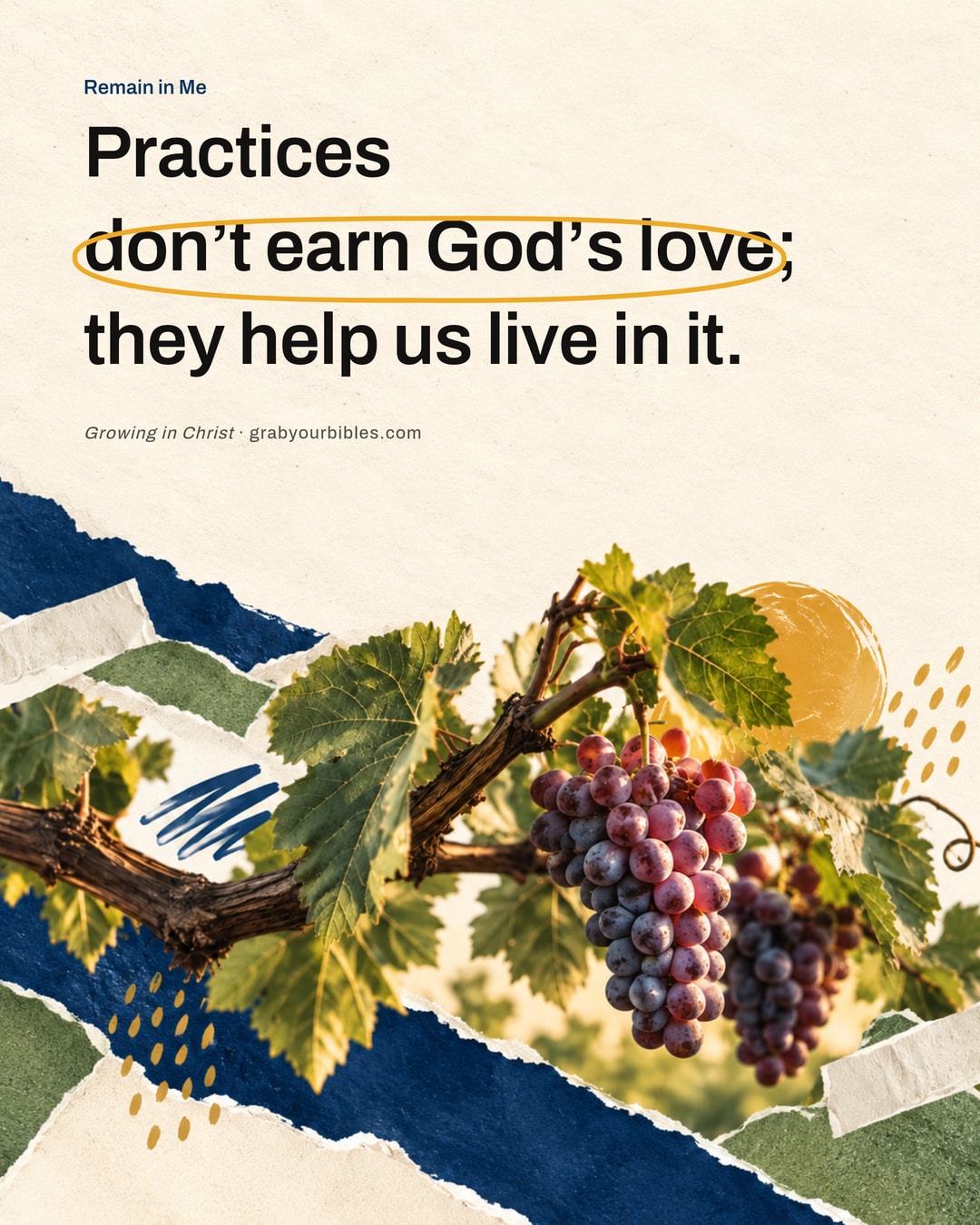
Practices don’t earn God’s love; they help us live in it.